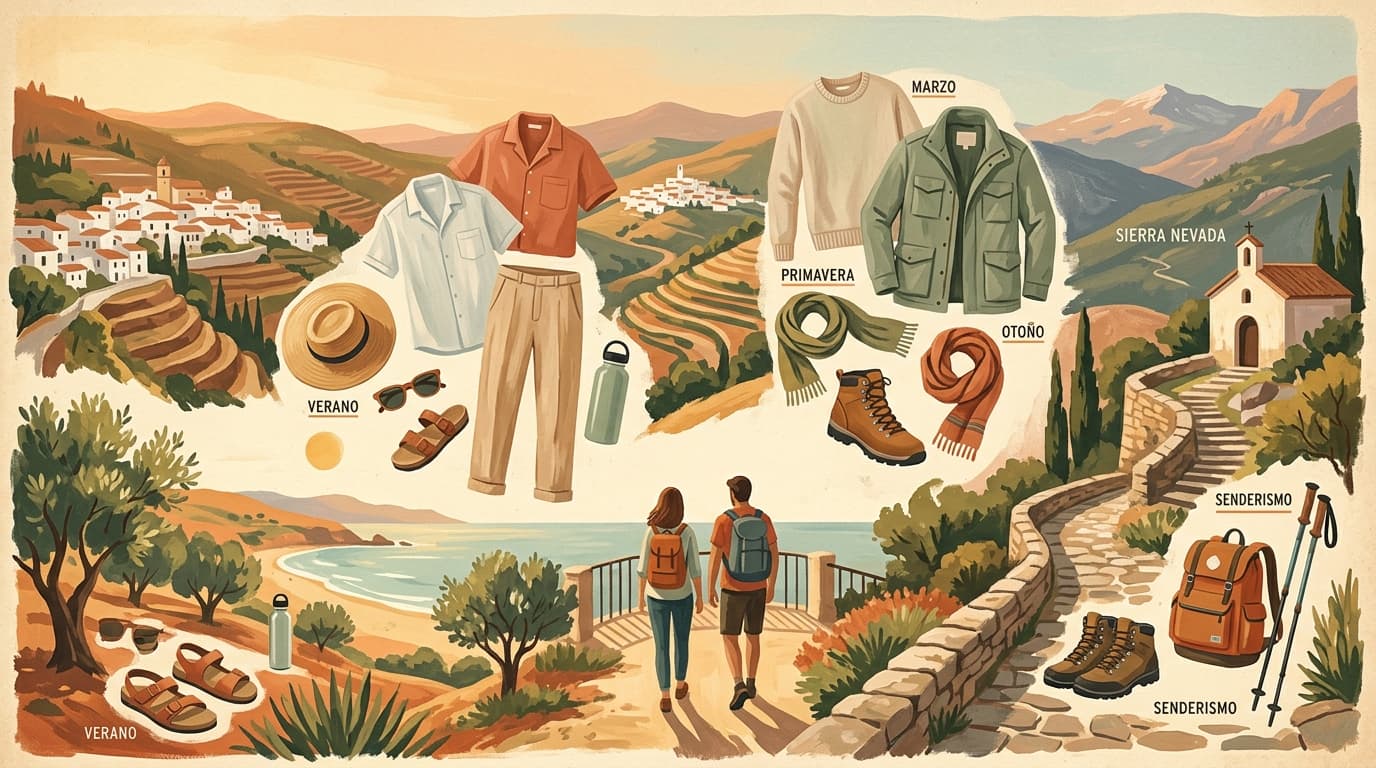
practical
Packing Guide for Andalucía: Monthly Clothing and Equipment Essentials
A practical breakdown of what to pack for Andalucía based on regional temperatures and seasonal shifts, from mid-summer heatwaves to cool mountain winters.
practical
Packing Guide for Andalucía: Monthly Clothing and Equipment Essentials
14 April 2026 · 6 min read · 1,229 words
Packing for Andalucía requires planning for significant temperature swings between the coast and inland cities, as well as distinct seasonal shifts. This guide provides a monthly breakdown and practical advice for every province.
To pack correctly for Andalucía, you must distinguish between the coastal climate and the inland furnace. From June to September, the focus is entirely on heat management. During the winter months, particularly in Granada and the Sierra Subbética, temperatures frequently drop to freezing at night. A versatile wardrobe consisting of breathable natural fabrics and adaptable layers is the most effective approach for any time of year.
Quick Answer: The Essentials
Pack lightweight linens and cottons for June through September to manage temperatures often exceeding 40°C. From November to March, bring a heavy coat and thermal layers if visiting Granada or Jaén, as inland winters are cold. Regardless of the month, pack sturdy, flat walking shoes for cobblestones. Always carry a light scarf or cardigan to cover shoulders and knees when entering cathedrals or the Mezquita-Catedral in Córdoba.
Monthly Packing Breakdown
Andalucía spans nearly 90,000 square kilometres, meaning weather varies by province. Use these guidelines to plan your luggage.
January and February
These are the coldest months. While the Costa del Sol may see daytime highs of 16°C, inland cities like Granada or Baza often hover between 0°C and 12°C.
- Clothing: A warm winter coat, gloves, and a scarf. Layers are vital because interiors without central heating can feel colder than the outdoors.
- Footwear: Waterproof boots or sturdy trainers.
- Note: Rain is common in the Grazalema mountains and western provinces (Cádiz/Huelva) during this period.
March and April
Spring is unpredictable. You may experience 25°C sunshine followed by heavy rain. This is the season of Semana Santa (Holy Week).
- Clothing: Light trousers, long-sleeved shirts, and a medium-weight jacket. Pack a formal outfit if you plan to attend religious processions.
- Accessories: A compact umbrella and sunglasses.
May and June
The transition to summer happens quickly. May is pleasant, but by mid-June, the heat in Seville and Córdoba begins to intensify.
- Clothing: Short-sleeved cotton shirts, skirts, or light chinos. You will no longer need a heavy coat, but a light denim jacket or jumper is useful for late evenings on the coast.
- Average Highs: 24°C in May; 30°C+ in June.
July and August
This is the peak of the Andalucian summer. In the Guadalquivir valley (Seville, Córdoba), temperatures regularly hit 42°C–45°C.
- Clothing: Loose-fitting linen or technical sweat-wicking fabrics. Avoid dark colours and heavy denim.
- Essentials: High-SPF sunscreen (expect to pay €12–€18 per bottle in local pharmacies), a wide-brimmed hat, and a high-quality water bottle.
September and October
September remains very hot, while October sees a gradual cooling. This is often considered the best time for hiking.
- Clothing: Summer clothes for the daytime, but introduce a light sweater for October evenings.
- Footwear: Transition from sandals back to closed-toe shoes.
November and December
Winter returns, often accompanied by the first snow in the Sierra Nevada. The humidity on the coast can make 15°C feel much colder.
- Clothing: Thermal base layers if visiting mountain villages, a windproof jacket, and woollen socks.
- Average Lows: 4°C–7°C inland.
Summer Heat Preparation
Managing the heat is a matter of safety, not just comfort. The sun in Southern Spain is significantly stronger than in Northern Europe.
- Fabrics: Stick to 100% linen or cotton. Synthetic blends often trap heat and cause discomfort during the 2:00 PM to 6:00 PM peak heat period.
- Hydration: Carry a 1-litre insulated bottle. Public drinking fountains (fuentes) are common in cities like Granada and are safe to use, saving you roughly €2 per plastic bottle.
- Eye Protection: Polarised sunglasses are recommended to combat the intense glare from white-washed buildings (pueblos blancos).
Winter and Mountain Layers
Many visitors underestimate the cold in Granada. Because the city sits at 738 metres above sea level at the foot of the Sierra Nevada, it is significantly colder than Málaga, which is only 90 minutes away.
- The 3-Layer Rule: Use a moisture-wicking base, an insulating mid-layer (fleece or wool), and a windproof/waterproof outer shell.
- Accommodation Note: Many older rental properties and Airbnbs in Andalucía lack wall insulation. Pack warm loungewear or thick slippers for indoor use.
Footwear for Cobblestones and Hills
A typical day of sightseeing in Seville or the Albaicín in Granada involves walking between 10,000 and 20,000 steps. The terrain is often uneven, polished marble or ancient cobblestones.
- Trainers: Choose shoes with good arch support and grip. Thin-soled pumps or Converse will lead to foot fatigue on stone surfaces.
- Sandals: Ensure they have straps. Flip-flops are suitable for the beach but dangerous for climbing the steep, slick streets of Arcos de la Frontera or the steps of the Alhambra.
- Evening Wear: Espadrilles are a local staple; they are stylish, breathable, and culturally appropriate for dinner.
Dress Codes for Religious Sites
While Andalucía is relaxed regarding fashion, major religious landmarks enforce strict entry requirements. These include the Seville Cathedral, the Mezquita-Catedral de Córdoba, and the Cathedral of Granada.
- Shoulders: Must be covered. A shawl or pashmina in your bag is a practical solution for summer travellers wearing tank tops.
- Knees: Shorts and skirts should reach the knee. Some sites may deny entry or ask you to wrap a scarf around your waist.
- Headwear: Men are expected to remove hats when entering.
Swimwear and Beach Etiquette
On the Costa del Sol, Costa de la Luz, and Costa Almería, beach attire is standard. However, wearing swimwear away from the sand is generally frowned upon.
- Beach to Bar: Always put on a T-shirt or sarong before entering a chiringuito (beach bar) or shop. In some cities, like Málaga, walking through the centre in swimwear can result in a fine of up to €300.
- Nudism: Common on designated beaches (e.g., Playa El Playazo in Vera). Pack accordingly if you plan to visit these areas.
Frequently Asked Questions
Can I wear shorts in the evening?
In coastal resorts, shorts are acceptable for evening meals. However, in cities like Seville or Granada, locals tend to dress more formally for dinner. Chinos or linen trousers are a better choice for men, while sundresses or trousers are standard for women.
Do I need an umbrella?
If visiting between November and March, yes. While Andalucía is famous for sun, it experiences heavy Atlantic fronts. Rain is often torrential rather than a drizzle, so a sturdy umbrella is better than a cheap travel version.
What should I pack for the Alhambra?
The Alhambra involves several hours of walking on varied terrain. Wear your most comfortable trainers, a hat, and carry a refillable water bottle. There are water stations throughout the complex where you can refill for free.
Is a money belt necessary?
While Andalucía is generally safe, pickpocketing occurs in crowded tourist spots like the Santa Cruz district in Seville. A crossbody bag with a zip is usually sufficient, but ensure it is kept to your front in crowds.
Summary
- Summer (June-Sept): Lightweight linens, high SPF, and wide-brimmed hats are mandatory.
- Winter (Nov-Feb): Heavy coats and layers are essential for inland and mountain regions.
- Footwear: Prioritise support and grip for cobblestones; avoid thin-soled shoes.
- Etiquette: Carry a scarf for cathedral dress codes and cover up when leaving the beach.
Note: Weather patterns are shifting; always check a 7-day forecast before departure as heatwaves can occur as early as April.
More guides
Senior Travel Guide to Andalucía: Planning and Practical Advice
Andalucía is highly accessible for senior travellers, provided you account for the summer heat and steep terrain in historical quarters. This guide covers transport discounts, medical access, and mobility tips.
5 min read
Read guide →
Electricity, Plugs and Adaptors in Andalusia: A Practical Guide
A practical guide to electricity in Andalusia, covering plug types C and F, 230V voltage requirements, and essential advice for using UK and US appliances.
5 min read
Read guide →
Co-working Spaces and Digital Nomad Life in Andalucía
A practical guide to the best co-working hubs and digital nomad infrastructure across Andalucía, including costs, internet speeds, and community locations.
4 min read
Read guide →
LGBTQ+ Travel Guide to Andalucía
A practical guide to safety, nightlife, and legal rights for LGBTQ+ travellers and residents in Andalucía.
4 min read
Read guide →
Best Time to Visit Andalucía: Weather, Prices, and Festivals
Discover the best time to visit Andalucía with our practical guide to seasonal weather, price drops, and the regional festival calendar.
5 min read
Read guide →
Luggage Storage in Andalucía: A Guide to Stations, Lockers, and Apps
A practical guide to luggage storage in Andalucía, covering train station lockers, airport facilities, and the best storage apps for Seville, Málaga, and Granada.
5 min read
Read guide →
Getting Around Andalucía: Trains, Buses, and Car Hire
A practical guide to navigating Andalucía using high-speed trains, regional bus networks, and car hire for rural areas.
5 min read
Read guide →
Tap Water and Drinking Water in Andalucía: A Practical Guide
A practical guide to drinking water in Andalucía, covering tap water safety, mineral content by province, and where to buy bottled water.
4 min read
Read guide →
Postal Services and Sending Parcels in Andalucía
A practical guide to using Correos, sending international parcels, and navigating courier services like SEUR and MRW in Andalucía.
5 min read
Read guide →Newsletter
More stories from Andalucía
Weekly notes, seasonal picks, and the next guides worth bookmarking.