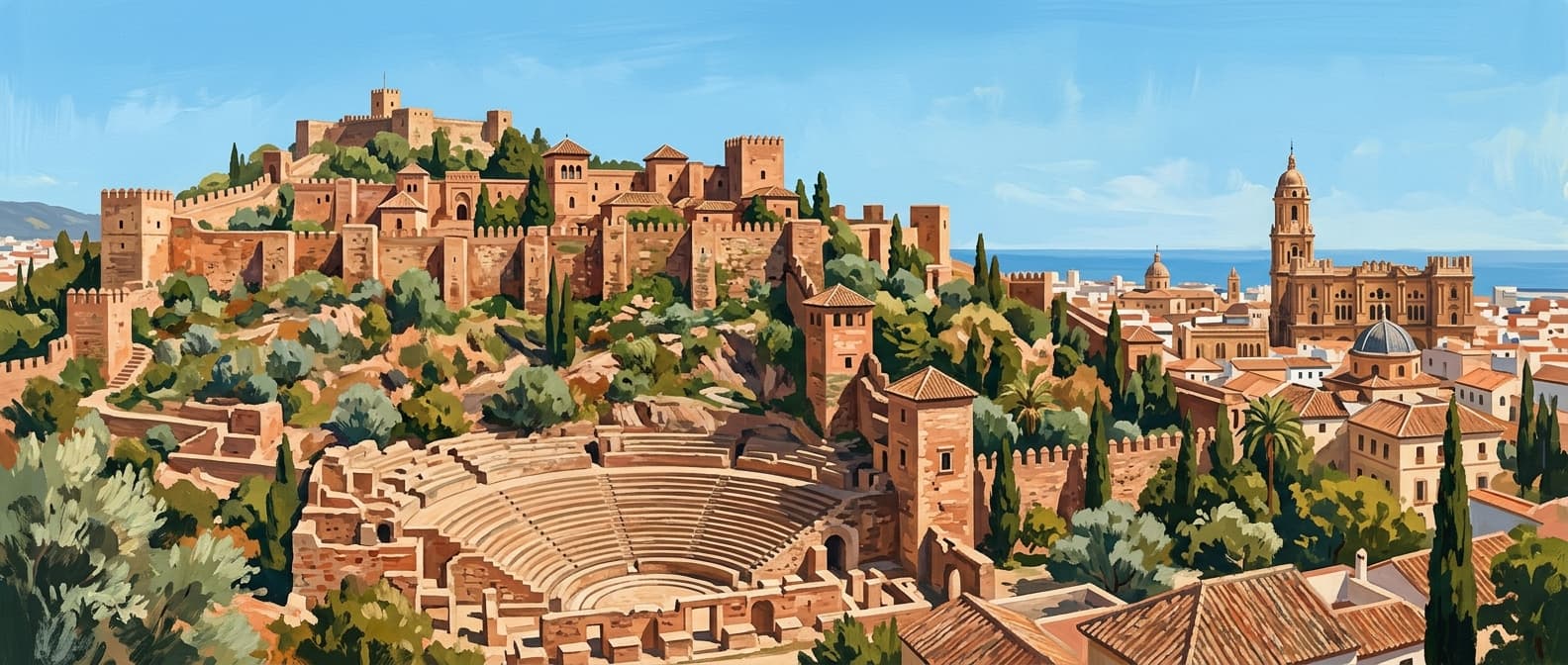
Málaga’s skyline is defined by the stone ramparts of the Alcazaba, a fortress that has watched over the Mediterranean for nearly a thousand years. At its feet lie the sun-bleached tiers of a Roman theatre, creating a remarkable physical timeline of the city’s ancient and Moorish eras.
Standing on Calle Alcazabilla, you are presented with one of the most striking archaeological views in southern Spain. To your left, the sheer glass and steel of the modern city; directly in front, the 1st-century Roman theatre; and rising steeply behind it, the brick-and-stone fortifications of the Alcazaba. This site is not merely a collection of ruins but the historical heart of Málaga, where the city’s Roman, Moorish, and Christian identities physically overlap.
While many visitors head straight for the beaches of the Costa del Sol, these two monuments offer a different pace. They provide a cool retreat into manicured gardens and cool stone corridors, offering some of the best vantage points over the port and the Alboran Sea. Exploring them together takes you from the entertainment of the Roman Empire to the defensive precision of the Hammudid dynasty, all within a few hundred metres.
What to See & Do
The transition from the Roman theatre to the Alcazaba involves a short, steep walk, but the two sites are fundamentally linked. During the construction of the Moorish fortress, the Roman theatre served as a convenient quarry; many of the marble columns and stones you see in the Alcazaba today were originally part of the Roman structure below.
The Roman Theatre (Teatro Romano)
Built during the reign of Augustus in the 1st century BC, the theatre remained in use for roughly three hundred years before being abandoned. Remarkably, it was only rediscovered in 1951 during the landscaping of the ‘Casa de la Cultura’ gardens. Today, you can walk through the modern Interpretation Centre, which uses glass-etched maps to explain the theatre’s original layout, before stepping out onto the wooden walkways.
The theatre is divided into the cavea (the tiered seating), the orchestra (the semi-circular space at the front for dignitaries), and the proscaenium (the stage). Look closely at the seat remains; you can still see the original stone carving. Near the entrance, you will also notice several large stone basins. These were part of a Roman factory used to produce garum, a fermented fish sauce that was a staple export of Roman Málaga.
The Alcazaba Fortress
The Alcazaba is often described as a smaller version of Granada’s Alhambra, but its purpose was far more defensive. Built primarily in the 11th century, it features a double wall system that made it nearly impregnable. To enter, you pass through a series of ‘bent entrances’—gates designed with sharp turns to slow down charging invaders.
As you ascend, the military architecture softens into palace life. The lower enclosure contains the Plaza de Armas, now a garden filled with jasmine, bougainvillea, and orange trees. The sound of running water is constant here, flowing through narrow brick channels that were designed to keep the air cool during the heavy heat of an Andalusian summer.
The Nazari Palace and Gardens
In the upper enclosure, you find the Cuartos de Granada, the living quarters of the Moorish governors. While less sprawling than the palaces in Seville or Granada, the detail is extraordinary. Key features include the Mudejar ceilings, intricate plasterwork, and the triple-arched gateway leading into the patio. From the battlements of the Torre del Homenaje, the views open up across the city, the Cathedral (known as ‘La Manquita’), and the sprawling modern port area.
The Archaeological Museum
Inside the palace complex, a small but focused museum houses Phoenician, Roman, and Moorish ceramics found during various excavations on the hill. It is well worth ten minutes of your time to see the delicately glazed Moorish pottery, which provides context for the people who once inhabited these stone halls.
Practical Information
Visiting the Roman Theatre and the Alcazaba is straightforward, as they sit adjacent to one another in the city centre. It is best to visit the Roman Theatre first, as it is a shorter visit and provides the base layer for the history of the site.
Opening Times:
Roman Theatre: Tuesday to Saturday, 10:00 to 18:00; Sundays and public holidays, 10:00 to 16:00. Closed on Mondays.
Alcazaba: Summer (1 April to 31 October) 09:00 to 20:00; Winter (1 November to 31 March) 09:00 to 18:00. The site is open seven days a week, though last entry is 45 minutes before closing.
Ticket Prices (2026):
Roman Theatre: Entry is free for everyone.
Alcazaba: General admission is €7.00. If you plan to visit the Gibralfaro Castle at the top of the hill (accessible via a steep walk or the number 35 bus), a combined ticket is available for €10.00. Reduced tickets for students and seniors are €3.00 (€5.00 for a combined ticket). Entry to the Alcazaba is free for all every Sunday after 14:00.
How to Get There:
The site is located on Calle Alcazabilla. Most city centre buses stop at the nearby Paseo del Parque or Alameda Principal. From there, it is a five-minute walk. If you are driving, the nearest public car park is the Parking Central at Plaza de la Marina, roughly 400 metres away.
Where to Eat Nearby
Immediately opposite the Roman Theatre is El Pimpi, perhaps Málaga’s most famous bodega. While the terrace offers great views of the ruins, the interior is the real draw. It is a labyrinth of old barrels signed by celebrities (including local son Antonio Banderas) and tiled courtyards. Order a glass of Málaga Virgen (sweet wine) and a plate of jamón ibérico.
For a different perspective, Batik is situated on the fourth floor of the Alcazaba Premium Hostel. This restaurant features a rooftop terrace with an elevated view over the Roman Theatre and the fortress walls. The menu is a modern take on Mediterranean flavours, such as slow-cooked pork cheek or grilled octopus. It is an ideal spot for a late lunch once the midday sun begins to dip.
Where to Stay
For those who wish to wake up with a view of the fortress, Palacio Solecio is a beautifully restored 18th-century palace in the Jewish Quarter, just a short walk from the entrance. It offers a refined, quiet atmosphere in the heart of the city. Alternatively, Hotel Alcazaba Premium provides a more casual, social environment with the added benefit of that aforementioned rooftop terrace. Both options put you within easy reach of the Cathedral and the Picasso Museum.