route · Córdoba
The Ultimate Jamón Ibérico Route: Through Huelva and Córdoba
Tracking down the world's finest ham is an exercise in geography, patience, and appetite. This three-day drive through the ancient oak forests of Huelva and Córdoba takes you straight to the source of authentic Jamón 100% Ibérico de Bellota.
route · Córdoba
The Ultimate Jamón Ibérico Route: Through Huelva and Córdoba
14 April 2026 · 9 min read · 1,934 words
Tracking down the world's finest ham is an exercise in geography, patience, and appetite. This three-day drive through the ancient oak forests of Huelva and Córdoba takes you straight to the source of authentic Jamón 100% Ibérico de Bellota.
To truly understand rural western Andalucía, you have to understand the pig. The Iberian pig is the absolute centre of gravity for the economies, landscapes, and culinary traditions of the northern stretches of Huelva and Córdoba. This is where the revered Jamón 100% Ibérico de Bellota is forged—a product reliant on a highly specific ecosystem, strict genetics, and up to four years of silent, dark cellar ageing.
Most visitors experience Iberian ham as an expensive luxury sliced thinly onto a warm plate in a Seville tapas bar. But to consume it at the source, pulling into the mountain villages where the air itself smells faintly of curing fat and salt, elevates the experience entirely. You will see the pigs rooting under the oaks, walk through cellars hanging with tens of thousands of curing legs, and learn precisely why this meat commands its price tag.
This three-day route traverses two distinct Protected Designations of Origin (PDOs): the legendary and historic PDO Jabugo in the Sierra de Aracena, and the newer, deeply highly regarded PDO Los Pedroches in northern Córdoba. It requires a fair bit of driving along winding secondary roads, but the reward is unprecedented access to the absolute pinnacle of Spanish gastronomy.
The Ecosystem: Navigating the Dehesa
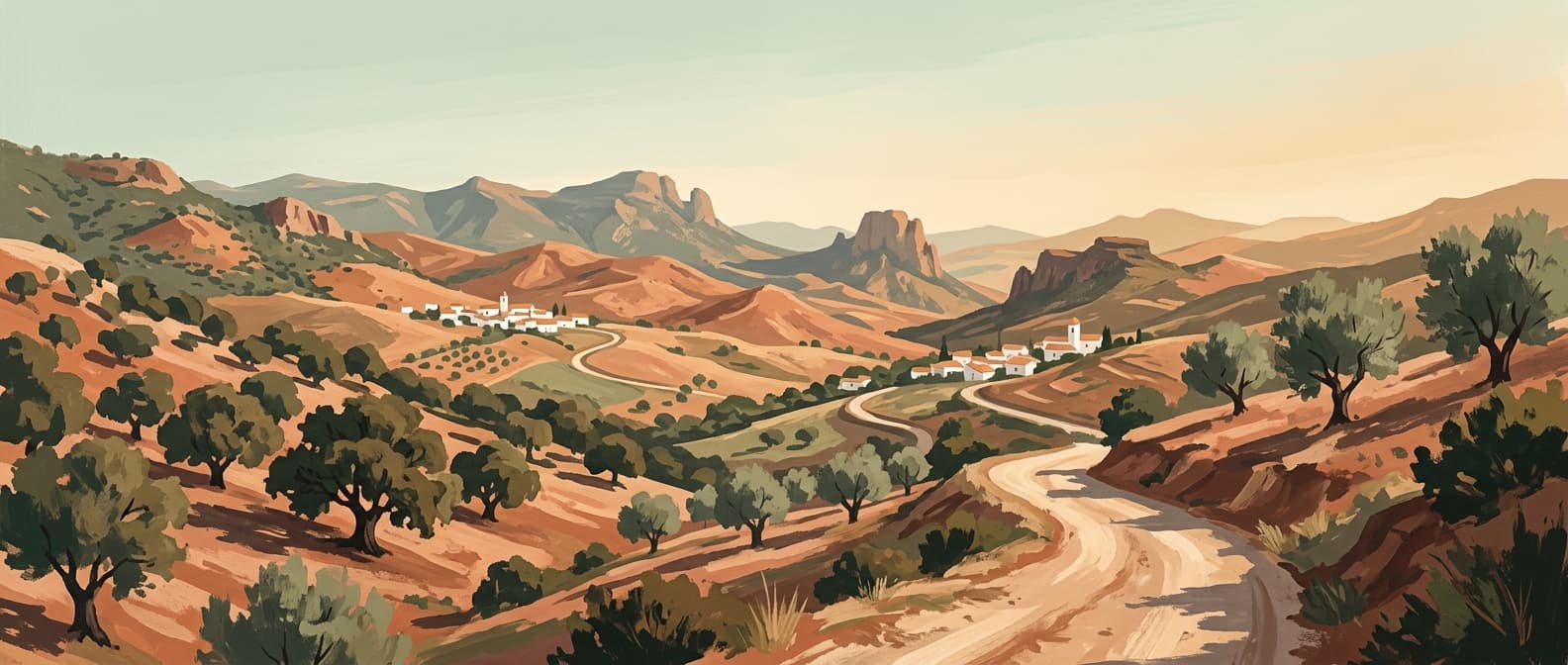
Before you even taste the ham, you will spend hours driving through its incubator. The dehesa is a managed, man-made ecosystem—a vast, rolling savannah of holm oaks (Quercus ilex) and cork oaks (Quercus suber) covering huge swathes of south-western Spain.
During the crucial montanera season (roughly October to March), the acorns (bellotas) fall to the ground. The purebred Iberian pigs, previously ranging freely and eating grass and roots, begin consuming up to eight kilos of acorns a day. It is this specific diet, combined with the continuous physical exercise of foraging across steep terrain, that causes the oleic acid to marble perfectly into the muscle tissue. When you see endless drystone walls flanking the N-433 road, you are looking at estates where this vital fattening process occurs. Keep your speed low; these roads are narrow, and agricultural vehicles—or occasionally the pigs themselves—often dictate the pace.
Day 1: Into the Heart of Huelva (Aracena to Jabugo)
Your route begins in the Sierra de Aracena, entering via the N-433 from the direction of Seville. Base yourself in Aracena for the first night—it is the largest town in the area, offering excellent dining options and a reliable starting point for early morning drives. [AFFILIATE: hotel: Hotel Convento Aracena].
The Factory Floors of Jabugo
From Aracena, take the winding HU-8105 west towards Jabugo. This 20-kilometre stretch is arguably one of the most scenic drives in the province, cutting directly through dense chestnut and oak forests. Jabugo itself is surprisingly industrial on the outskirts. The town exists almost entirely to cure meat, aided by a unique microclimate where cold mountain winds naturally regulate the drying rooms.
Your first essential stop is a structured factory tour. You cannot wander into a curing facility unannounced; strictly enforced hygiene and security rules apply. Book a visit at Cinco Jotas (Sánchez Romero Carvajal), the oldest and most famous producer in the village. [AFFILIATE: tour: Cinco Jotas Bodega Tour and Tasting].
During the tour, pay close attention to the sheer scale of the bodegas (cellars). You will be guided through the four phases of production: the initial salazón (burying the legs in coarse sea salt), the asentamiento (resting in cold rooms to let the salt penetrate), the secado or sudado (where the hams hang in natural drying rooms and 'sweat' out their fat as summer temperatures rise), and finally, the long maduración in the dim, fungus-coated underground cellars. The smell here is unforgettable—a heavy, earthy aroma of dry aged meat, damp brick, and nutty fat.
Tasting Notes and Late Lunch
Following the tour, sit for a tasting. A true maestro cortador (master slicer) will demonstrate how to carve translucent, bite-sized pieces. Look for the intense ruby red colour and the flecks of white tyrosine crystals—a sign of a long, slow cure, not a defect. The fat should literally melt on your fingers at room temperature.
For lunch, avoid the temptation to just eat cured ham. Head to the Plaza de San Miguel in Jabugo or drive 10 minutes to the neighbouring village of Castaño del Robledo. Order fresh Iberian pork cuts, which are rarely exported with the same quality. Ask the waiter for presa ibérica (the marbled shoulder cut) or secreto (a highly fatty, flavourful cut from the armpit), grilled simply over holm oak coals and served with coarse salt.
Day 2: The Northern Frontiers (Cumbres Mayores and Cortegana)
Check out early and take the N-435 northwards. This road demands concentration. The tarmac is well-maintained, but the endless series of blind corners and elevation changes require sensible driving. You are heading towards Cumbres Mayores, a town sitting at a higher altitude near the border with Extremadura.
The High-Altitude Cure
Cumbres Mayores has a long agricultural lineage regarding pork production, frequently overshadowed by Jabugo. However, the higher altitude here means the air is drier and colder. Producers in this village often favour a slightly longer curing time, resulting in a ham that is intensely concentrated in flavour, with a slightly firmer texture.
Spend the morning walking around the impressive 13th-century Castillo de Sancho el Bravo, an unusual fortress built directly into the village layout. Many local producers operate small shops in the streets directly beneath the castle walls. This is an excellent place to buy vacuum-packed slices if you want high quality without the premium brand markup found in Jabugo.
Cortegana and the Afternoon Drive
In the afternoon, loop back south via the HU-8100 to Cortegana. The fortress here commands extraordinary views over the dehesa you have just driven through. Cortegana is an excellent stop for a late afternoon coffee and a tostada con manteca colorá—toasted local bread spread with orange-hued pork lard infused with paprika. It is a dense, deeply traditional mountain snack that will keep you going until dinner.
Settle into a rural guesthouse around Cortegana or Almonaster la Real for your second night. [AFFILIATE: hotel: Posada de Cortegana].
Day 3: East to Córdoba’s Acorn Capital (Los Pedroches)
Warning: Today involves a significant drive. Transitioning from the Sierra de Aracena in Huelva to the Valle de los Pedroches in northern Córdoba takes roughly two and a half to three hours. You will need to take the N-433 back east, join the A-66 heading north briefly, and then cut across the N-432 and A-424. Start your engine by 8:30 AM to make the most of the day.
A Different Terroir
As you cross into the province of Córdoba and enter the Valle de los Pedroches, the landscape subtly shifts. The terrain is flatter, dominated by granite outcrops and an even denser concentration of ancient holm oaks. The Los Pedroches PDO was only officially recognised in 2006, but it has rapidly gained a reputation among Spanish chefs for producing hams with a remarkably sweet, nuanced profile. The acorns here are particularly high in sugars, which translates directly into the meat.
Your destination is Villanueva de Córdoba, the undisputed capital of the Los Pedroches ham industry. The town feels distinctly different from the steep, damp villages of Huelva; it is a wide, bright agricultural hub.
Secadero Visit and The Cala
Book an afternoon visit at a local producer such as Señorío de Los Pedroches or Belloterra. [AFFILIATE: tour: Belloterra Dehesa and Secadero Experience]. These tours often include a guided walk directly into the dehesa, allowing you to get much closer to the roaming pigs than you typically can in Huelva.
During the cellar tour here, ask to see the cala process. Before any ham is certified and sold, a specialist inserts a thin, needle-like sliver of cow or horse bone into three specific joints of the ham. They immediately withdraw it and smell the bone to ensure the curing process is flawless and no internal rot has occurred. It is a process relying entirely on the olfactory memory of the inspector.
Finish your route by spending the night in nearby Pozoblanco. [AFFILIATE: hotel: Hotel HC Zoom Pozoblanco]. The town has a surprisingly busy restaurant scene, allowing you to celebrate the end of the road trip with a final platter of black-tag ham and a glass of dry Fino sherry from Montilla-Moriles—the perfect acidic pairing to cut through the rich, coating fat.
The Law of the Label: A Strict Buying Guide
If you intend to purchase ham to take home, you must understand the 2014 Norma de Calidad del Ibérico (The Iberian Quality Standard). Do not buy based on the word "Ibérico" alone, as it can be legally applied to cross-bred pigs raised indoors on commercial feed. Instead, look strictly at the coloured plastic tag (brida) attached to the trotter:
- Black Tag (Brida Negra): The absolute pinnacle. 100% purebred Iberian pig, free-ranging, and fed exclusively on acorns and natural pasture during the montanera. This is what you have travelled to buy.
- Red Tag (Brida Roja): Free-ranging and acorn-fed, but the pig is a crossbreed (usually 50% or 75% Iberian, crossed with a Duroc). Excellent quality, but lacking the supreme marbling and fat profile of the black tag.
- Green Tag (Brida Verde): Cebo de Campo. The pig is free-ranging but fed on commercial grain and legumes, not acorns.
- White Tag (Brida Blanca): Cebo. The pig is intensively farmed indoors and fed on commercial grain. Avoid this if you are travelling all the way to the source.
Expect to pay anywhere from €60 to €150 per kilo for vacuum-packed, hand-carved Black Tag ham. Buying a whole leg (which weighs between 6.5kg and 8kg) requires a commitment of €400 to €800, plus the cost of a specialized stand (jamonero) and carving knife (cuchillo jamonero).
Practical Information
When to Go
The ideal time for this route is between late October and early March. This aligns perfectly with the montanera, meaning you will actually see the pigs out in the dehesa eating acorns. The weather will be crisp and cold—perfect for eating heavy meats. Avoid July and August entirely; temperatures in Córdoba frequently exceed 40°C, the pigs are largely inactive in the shade, and many smaller producers close for holidays.
Driving and Navigation
You need a reliable rental car for this route. Public transport between these rural mountain villages is practically non-existent. Ensure your tyres and brakes are in excellent condition, as the roads in the Sierra de Aracena are notoriously twisting. Furthermore, drive with extreme caution at dawn and dusk; wild boar and deer frequently cross the N-433 and N-435.
What to Bring
Pack a high-quality cool bag. While whole cured hams do not require refrigeration, vacuum-packed slices are best kept at a stable, cool temperature during long car journeys to prevent the delicate fat from melting into an oily mess before you get home. Bring sturdy walking boots for the farm tours, as the dehesa terrain is uneven and often muddy in winter.
Booking in Advance
Do not assume you can walk into a factory for a tour. The major facilities in Jabugo and Los Pedroches require bookings at least a week in advance, as they have to coordinate guides and manage visitor flow around active production lines. English-speaking tours are available but are less frequent than Spanish ones, so verify the language when booking.
More from Córdoba
The Ultimate Andalucía Photography Route: Chasing Light Across Southern Spain
Forget the bleached-out midday snaps and crowded tourist viewpoints; photographing southern Spain requires an obsession with timing and terrain. This comprehensive route guides you to the exact coordinates and precise hours needed to capture the region's finest architectural geometry and dramatic geology.
9 min read
Read guide →
Roman Andalucía Heritage Trail
Before the Moorish emirs reshaped southern Spain, this territory was the fiercely wealthy Roman province of Baetica, a crucial supplier of olive oil and emperors to the empire. This seven-day route traces the classical footprint across Andalucía, leading you from coastal fish-salting ruins and lonely mountain amphitheatres to the architectural remnants that bridged the fall of Rome and the rise of Al-Andalus.
10 min read
Read guide →
The Alpujarras Complete Guide: High Altitudes and Moorish Footpaths
South of the Sierra Nevada, the Alpujarras is a high-altitude network of steep ravines, ancient irrigation channels, and white villages clinging to the mountainside. This guide covers how to navigate the hairpin bends, where to find the best hiking trails, and which village suits your basecamp needs.
9 min read
Read guide →
Best Weekend Breaks in Andalucía
When you live in southern Spain, the temptation is to spend every weekend repeating the same comfortable Sunday routines. These seven targeted 48-hour itineraries bypass the obvious tourist traps, giving residents and expats a genuine excuse to pack a weekend bag and drive somewhere entirely new.
11 min read
Read guide →
One Week in Andalucía Itinerary: The Classic Triangle & Ronda
Seven days in southern Spain is just enough time to trace the defining Moorish capitals and mountain roads of Andalucía. This itinerary strips away the coastal sprawl to focus entirely on the essential cities of Málaga, Granada, Córdoba, and Seville, returning via the dramatic mountain gorge of Ronda.
9 min read
Read guide →
Budget Backpacker Guide to Andalucía
Andalucía on a shoestring is entirely possible if you know where to eat, how to travel, and which timing tricks unlock the region's monuments for free. This guide strips away the tourist premium to show you exactly how to backpack southern Spain on less than €50 a day.
9 min read
Read guide →
Motorcycle Touring in Andalucía: The Ultimate Rider's Guide
Forget the motorways; Andalucía’s true character is carved into its mountain passes, where immaculate asphalt drapes across deep ravines and high-altitude plateaus. This is a landscape built for motorcycles, offering thousands of kilometres of technical riding without a straight line in sight.
9 min read
Read guide →
Doñana National Park Guide: Marshes, Lynx, and Restricted Zones
A shifting landscape of tidal marshes, ancient pine forests, and wind-sculpted dunes, Doñana is Europe's most crucial wetland reserve. Navigating its restricted zones requires planning, but the reward is encountering Iberian lynx and thousands of migratory flamingos in total wilderness.
9 min read
Read guide →
Feria de Abril Complete Guide: Surviving and Thriving in Seville's Greatest Week
Seville’s Feria de Abril is notoriously impenetrable for outsiders, a closed-doors celebration of Andalusian high society and endless rebujito. This guide strips away the confusion, detailing exactly how to navigate the public casetas, master the unforgiving dress code, and survive a week on the sand of Los Remedios.
10 min read
Read guide →Newsletter
More stories from Andalucía
Weekly notes, seasonal picks, and the next guides worth bookmarking.