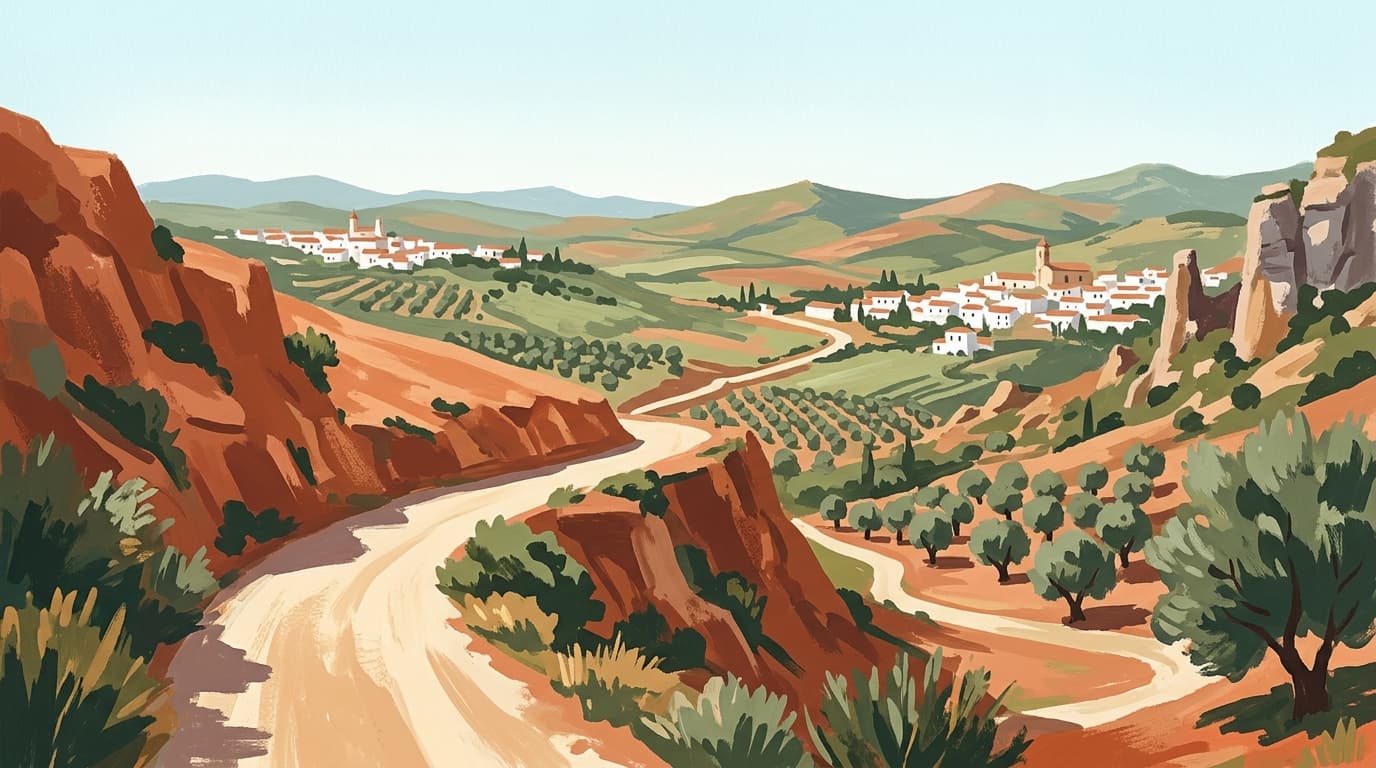
route · Málaga
One Week in Andalucía Itinerary: The Classic Triangle & Ronda
Seven days in southern Spain is just enough time to trace the defining Moorish capitals and mountain roads of Andalucía. This itinerary strips away the coastal sprawl to focus entirely on the essential cities of Málaga, Granada, Córdoba, and Seville, returning via the dramatic mountain gorge of Ronda.
route · Málaga
One Week in Andalucía Itinerary: The Classic Triangle & Ronda
14 April 2026 · 9 min read · 2,044 words
Seven days in southern Spain is just enough time to trace the defining Moorish capitals and mountain roads of Andalucía. This itinerary strips away the coastal sprawl to focus entirely on the essential cities of Málaga, Granada, Córdoba, and Seville, returning via the dramatic mountain gorge of Ronda.
A week in southern Spain is an exercise in ruthless prioritisation. The temptation for first-time visitors is to try and cover everything: the beaches of Cádiz, the high peaks of the Sierra Nevada, the white villages of the Alpujarras, and the great cities of the plains. Attempting this in seven days will leave you exhausted, spending more time looking at the bumper of a long-haul lorry than medieval architecture.
This itinerary is deliberately focused. It traces the historic golden triangle of Granada, Córdoba, and Seville, using Málaga as a highly practical entry and exit point, and threads the needle through the serrated limestone mountains of Ronda on the return leg. It is a relentless, fast-paced schedule designed for confident drivers who do not mind changing hotels almost every night.
By hiring a car, you gain control over your timetable and access to the secondary roads that make driving here so rewarding. You will swap the sterile motorways for the N-432, an undulating single-carriageway tracing the old Caliphate route through endless olive groves, and the A-397, a dramatic sweep of tarmac that drops from the mountain plateau of Ronda down to the Mediterranean Sea. If you prefer to let someone else take the wheel, this exact route can be replicated using the excellent Renfe AVE and Avant high-speed train networks, swapping the mountain roads for high-speed rail lines.
Day 1: Arrival in Málaga
Málaga has spent the last decade shedding its reputation as merely an airport transit hub. It is now a primary cultural destination, and dedicating your first day here is essential.
Collect your rental car from Málaga-Costa del Sol Airport (AGP) but do not attempt to drive into the historic pedestrianised centre. Instead, head straight for the underground Parking Marina or Parking Camas. Both are tight, multi-storey affairs—pull your wing mirrors in—but they position you perfectly for a day on foot.
Spend your morning walking the marble-paved Calle Larios towards the Picasso Museum, housed in the superb Palacio de Buenavista. By 1:30 PM, the hunger pangs should drive you towards the Mercado Central de Atarazanas. The fish stalls close by early afternoon, but the small tapas bars at the southern entrance remain open; order the boquerones fritos (fried anchovies) and a cold Victoria beer.
In the late afternoon, walk off your lunch by tackling the steep, pine-scented path up the Gibralfaro hill. The panoramic views over the bullring and the Mediterranean port provide a superb introduction to the region's geography.
Overnight: Málaga. [AFFILIATE: hotel Palacio Solecio] offers a faultlessly restored 18th-century Andalusian courtyard aesthetic right in the historic centre.
Day 2: The Climb to Granada
Driving distance: 130 kilometres (1 hour 30 minutes)
Leave Málaga after the 9:00 AM rush hour clears. You will take the A-45 motorway north, which begins an immediate, steep ascent out of the coastal basin. Notice how quickly the subtropical flora gives way to the arid, sun-baked hills of the interior. Join the A-92M at the Casabermeja junction, which connects directly to the A-92 into Granada.
Granada’s traffic system is notoriously hostile to non-residents, with camera-enforced restrictions in the centre (the Albaicín and Realejo neighbourhoods are heavily restricted). Program your navigation app directly to Parking San Agustín. It is punishingly narrow, but you will emerge right next to the cathedral.
Spend the afternoon exploring the Albaicín, the old Moorish quarter. The walk along the Carrera del Darro is undeniably beautiful, though highly congested. Instead of joining the crowds at the famous Mirador de San Nicolás for sunset, walk another fifteen minutes uphill via steep, cobbled staircases to the Mirador de San Miguel Alto. The view is wider, capturing the full scale of the Alhambra against the backdrop of the Sierra Nevada mountains, and you will share it with a fraction of the visitors.
Overnight: Granada. [AFFILIATE: hotel Parador de Granada] places you directly within the Alhambra complex, allowing you to walk the grounds after the daytime crowds have dispersed.
Day 3: The Alhambra and the Caliphate Route to Córdoba
Driving distance: 165 kilometres (2 hours 30 minutes)
Your morning belongs to the Alhambra. You must secure your tickets at least three months in advance, as the strict timed-entry slots for the Nasrid Palaces sell out completely. Arrive at the complex at 8:30 AM to catch the morning light hitting the intricate stucco work of the Court of the Lions. [AFFILIATE: tour Alhambra Fast-Track and Guided Tour] is highly recommended here, as the complex history of the Nasrid dynasty is difficult to decipher without an expert guide.
By 2:00 PM, return to your car. Ignore your navigation app if it suggests taking the A-92 and A-45 motorways to Córdoba. Instead, force it to route you via the N-432. This single-carriageway road is heavily policed by speed cameras, but it is visually vastly superior. You will drive through the heart of Spain's olive oil production—millions of trees arranged in perfect geometric lines across rolling hills. Stop at Alcalá la Real for a coffee in the town square and look up at the formidable Castillo de la Mota fortress looming overhead.
You will arrive in Córdoba by late afternoon. Check into your hotel and take a twilight walk across the Roman Bridge, looking back at the illuminated walls of the Mezquita-Catedral.
Overnight: Córdoba. [AFFILIATE: hotel Hospes Palacio del Bailío] offers ancient Roman ruins beneath its glass floors and a remarkably peaceful garden courtyard.
Day 4: The Mezquita and the Plains to Seville
Driving distance: 145 kilometres (1 hour 45 minutes)
Wake early. From Monday to Saturday, between 8:30 AM and 9:30 AM, the Mezquita-Catedral allows free entry for individual visitors. Beyond the cost saving, this hour offers a rare chance to walk quietly among the hundreds of candy-striped double arches before the large tour groups arrive. It is a profoundly atmospheric space, entirely unique in its fusion of Islamic and Christian architecture.
For lunch, avoid the tourist traps immediately surrounding the Mezquita. Walk ten minutes north to Taberna Salinas for a bowl of thick, cold salmorejo topped with Iberian ham and chopped boiled egg, followed by fried aubergines.
In the mid-afternoon, join the A-4 motorway heading southwest to Seville. This is the least engaging driving stretch of the week—a flat, straight motorway carrying heavy freight traffic. Put on an engaging podcast and settle in for the two-hour drive.
Seville's Barrio Santa Cruz is a labyrinth of narrow alleys where GPS signals fail and wing mirrors are routinely sacrificed. Do not attempt to drive into it. Park at the large underground facility on Paseo de Colón, beside the Guadalquivir River, and walk to your accommodation.
Overnight: Seville. [AFFILIATE: hotel Hotel Alfonso XIII] remains the absolute pinnacle of traditional Sevillian luxury, commissioned by the King of Spain for the 1929 Ibero-American Exposition.
Day 5: Deep Dive into Seville
Seville requires stamina. The sheer scale of its historical centre means you will cover significant distances on foot. Start at the Real Alcázar. Like the Alhambra, this royal palace requires booking weeks in advance [AFFILIATE: tour Alcázar and Cathedral Guided Tour]. The Mudéjar architecture here was built by Christian kings using Moorish craftsmen, creating an aesthetic unique to the Iberian Peninsula.
Directly opposite is the Seville Cathedral, the largest Gothic church in the world. Walk the thirty-four sloping ramps to the top of the Giralda bell tower for views across the city rooftops.
By 2:00 PM, the heat in Seville—even in spring and autumn—often dictates a tactical retreat. Embrace the local custom of a long, late lunch and a rest. Return to the streets around 6:00 PM, heading towards the Plaza de España in the María Luisa Park, best viewed as the sun begins to lower and the stonework turns a deep orange.
For dinner, cross the Puente de Isabel II bridge into the historically working-class neighbourhood of Triana. The atmosphere here is loud, informal, and fiercely local. Stop at Bodeguita Romero and order the montadito de pringá—a small, toasted sandwich filled with slow-cooked, incredibly tender pork and chorizo.
Day 6: South into the Serranía de Ronda
Driving distance: 130 kilometres (1 hour 45 minutes)
Leave Seville mid-morning on the A-376. The landscape changes dramatically once you pass Utrera. The flat agricultural plains give way to dense cork oak forests and limestone crags as you climb into the Serranía de Ronda. The road is wide and well-maintained, but requires attention as it sweeps through the mountain passes.
Ronda sits precariously on a high inland plateau, split neatly in two by the 120-metre-deep El Tajo gorge. Park at the underground Parking Martínez Astein on the newer side of town and walk the ten minutes to the Puente Nuevo, the astonishing 18th-century bridge that spans the chasm.
Ronda suffers from intense day-tripper traffic between 11:00 AM and 4:00 PM. By staying the night, you gain a massive advantage. When the coaches leave, the town empties out. The walk down the Camino de los Molinos into the valley for a view looking back up at the bridge becomes an entirely peaceful experience, and you can easily secure a table at the town's excellent tapas bars.
Overnight: Ronda. [AFFILIATE: hotel Catalonia Ronda] offers an infinity pool looking directly over the bullring and the surrounding mountain ranges.
Day 7: The Descent to the Coast
Driving distance: 105 kilometres (1 hour 30 minutes)
Your final driving leg back to Málaga Airport is arguably the most spectacular of the entire trip. The A-397 from Ronda down to San Pedro de Alcántara drops roughly 1,000 metres in altitude over just 47 kilometres.
This road is a continuous sequence of sharp hairpins and blind corners. It is not recommended for passengers prone to motion sickness, and you will need to rely heavily on engine braking rather than riding your brake pedal. However, the sweeping views of the Mediterranean Sea—and, on clear days, the Atlas Mountains of North Africa—are exceptional.
Once you hit the coast at San Pedro, join the AP-7 toll road eastwards. The small toll fee is absolutely worth paying to avoid the heavily congested, traffic-light-riddled A-7 coastal road. The AP-7 will deposit you directly at Málaga Airport, completing your circuit.
Practical Information
When to Go
Timing is critical. Do not attempt this itinerary in July or August. Temperatures in Córdoba and Seville routinely exceed 40°C, making afternoon exploration physically dangerous. The optimal windows are from mid-April to late May, and from late September to the end of October. November brings lower hotel rates and fewer crowds, but you must accept a higher risk of rain, particularly in the Grazalema mountains near Ronda.
Car Rental and Driving Realities
Hiring a car in Spain is generally straightforward, but thoroughly document your vehicle's condition before leaving the lot. Record a video on your phone clearly showing the wheels, tyres, and undercarriage, as these are common areas for dispute upon return.
In the cities, rely heavily on paid underground parking. Historic centres in Andalucía feature intricate one-way systems and streets originally designed for pack animals. A smaller rental car (such as a Volkswagen Polo or Seat Ibiza) will serve you far better than a large SUV when navigating these ancient layouts.
Booking Timelines
Spontaneity is the enemy of the first-time visitor in Andalucía. The marquee historical sites—the Alhambra in Granada and the Real Alcázar in Seville—operate on strict daily capacity limits. You must secure these tickets online at least two to three months prior to your arrival. If you fail to do so, your only recourse is often purchasing a significantly more expensive, privately guided group tour.
Costs and Budgeting
Expect to pay roughly €40 to €70 per day for a mid-tier rental car with comprehensive insurance. Petrol and AP-7 motorway tolls will add approximately €80 to €100 for the entire 700-kilometre loop. Underground parking in the cities is uniformly expensive, averaging €20 to €25 per 24-hour period. Budget accordingly, as leaving your car on the street in central Granada, Córdoba, or Seville is rarely a viable option.
More from Málaga
The Ultimate Andalucía Photography Route: Chasing Light Across Southern Spain
Forget the bleached-out midday snaps and crowded tourist viewpoints; photographing southern Spain requires an obsession with timing and terrain. This comprehensive route guides you to the exact coordinates and precise hours needed to capture the region's finest architectural geometry and dramatic geology.
9 min read
Read guide →
Roman Andalucía Heritage Trail
Before the Moorish emirs reshaped southern Spain, this territory was the fiercely wealthy Roman province of Baetica, a crucial supplier of olive oil and emperors to the empire. This seven-day route traces the classical footprint across Andalucía, leading you from coastal fish-salting ruins and lonely mountain amphitheatres to the architectural remnants that bridged the fall of Rome and the rise of Al-Andalus.
10 min read
Read guide →
The Alpujarras Complete Guide: High Altitudes and Moorish Footpaths
South of the Sierra Nevada, the Alpujarras is a high-altitude network of steep ravines, ancient irrigation channels, and white villages clinging to the mountainside. This guide covers how to navigate the hairpin bends, where to find the best hiking trails, and which village suits your basecamp needs.
9 min read
Read guide →
The Ultimate Jamón Ibérico Route: Through Huelva and Córdoba
Tracking down the world's finest ham is an exercise in geography, patience, and appetite. This three-day drive through the ancient oak forests of Huelva and Córdoba takes you straight to the source of authentic Jamón 100% Ibérico de Bellota.
9 min read
Read guide →
Budget Backpacker Guide to Andalucía
Andalucía on a shoestring is entirely possible if you know where to eat, how to travel, and which timing tricks unlock the region's monuments for free. This guide strips away the tourist premium to show you exactly how to backpack southern Spain on less than €50 a day.
9 min read
Read guide →
Motorcycle Touring in Andalucía: The Ultimate Rider's Guide
Forget the motorways; Andalucía’s true character is carved into its mountain passes, where immaculate asphalt drapes across deep ravines and high-altitude plateaus. This is a landscape built for motorcycles, offering thousands of kilometres of technical riding without a straight line in sight.
9 min read
Read guide →
Doñana National Park Guide: Marshes, Lynx, and Restricted Zones
A shifting landscape of tidal marshes, ancient pine forests, and wind-sculpted dunes, Doñana is Europe's most crucial wetland reserve. Navigating its restricted zones requires planning, but the reward is encountering Iberian lynx and thousands of migratory flamingos in total wilderness.
9 min read
Read guide →
Feria de Abril Complete Guide: Surviving and Thriving in Seville's Greatest Week
Seville’s Feria de Abril is notoriously impenetrable for outsiders, a closed-doors celebration of Andalusian high society and endless rebujito. This guide strips away the confusion, detailing exactly how to navigate the public casetas, master the unforgiving dress code, and survive a week on the sand of Los Remedios.
10 min read
Read guide →
Semana Santa Guide: Decoding Andalucía's Most Intense Week
Holy Week in Andalucía is a profound sensory experience of heavy incense, brass bands, and thousands of shuffling feet. This guide decodes the intricate schedules, unwritten rules, and distinct regional styles of Spain’s most intense cultural phenomenon.
9 min read
Read guide →Newsletter
More stories from Andalucía
Weekly notes, seasonal picks, and the next guides worth bookmarking.